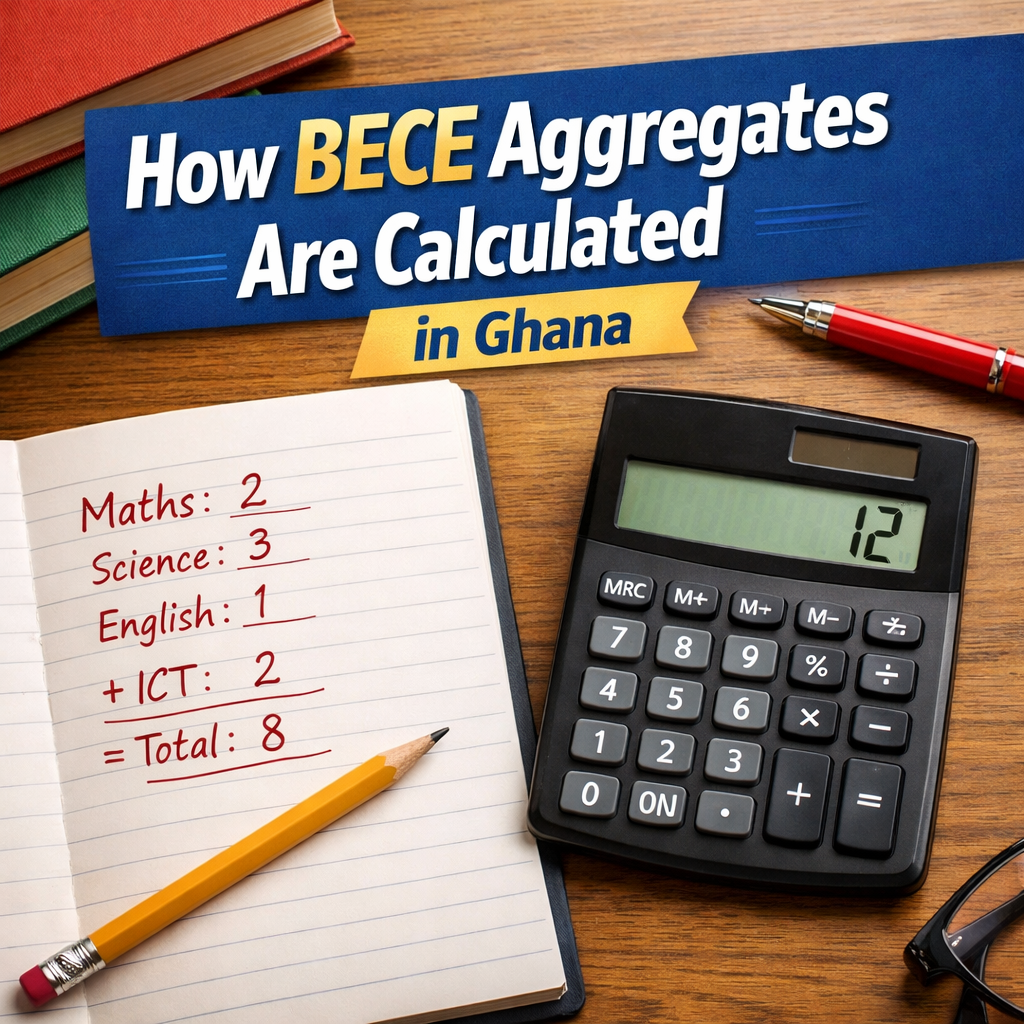
Every year in Ghana, thousands of students from the various public and private basic schools write the Basic Education Certificate Examination (BECE). After the results are released, one of the most common questions students and parents ask is:
“How is the BECE aggregate calculated?”
Understanding how the aggregate works is very important because it determines the chances of getting admission into a good Senior High School (SHS). In this guide, I will explain the process in a very simple way so students, parents, and teachers can easily understand it.
What Is BECE Aggregate?
The BECE aggregate is the total value calculated from a student’s best six subject's grade in the examination.
The lower the aggregate, the better the performance.
For example:
-
Aggregate 6 is excellent
-
Aggregate 10 is very good
-
Aggregate 30 is not very competitive for top schools
This means students should always aim to get the lowest possible aggregate.
Step 1: Understand the BECE Grading System
Each subject in BECE is graded from 1 to 9.
Here is what the grades mean:
| Grade | Meaning |
|---|---|
| 1 | Excellent |
| 2 | Very Good |
| 3 | Good |
| 4 | Good |
| 5 | Credit |
| 6 | Credit |
| 7 | Pass |
| 8 | Pass |
| 9 | Fail |
One important thing students should remember is that, in the grading system, a smaller number is better.
So a student with grade 1 in Mathematics performed better than a student with grade 4.
Step 2: Identify the Core Subjects
The BECE aggregate uses six subjects in total.
Out of these six subjects, four are core subjects that every student must write.
The four core subjects are:
-
English Language
-
Mathematics
-
Integrated Science
-
Social Studies
These subjects are always included in the aggregate calculation.
Step 3: Choose the Two Best Elective Subjects
Students normally write more than six elective subjects, but only two with the best grades are added to the four core subjects.
Some common elective subjects include:
-
Computing
-
Religious and Moral Education (RME)
-
French
-
Creative Arts and Design
-
Career Technology
-
Ghanaian Language
Out of all the electives, only the best two grades are selected.
Step 4: Convert the Grades to Numbers
The grades already come in numbers from 1 to 9, so calculating the aggregate simply involves adding the numbers together.
Example results:
| Subject | Grade |
|---|---|
| English | 2 |
| Mathematics | 3 |
| Integrated Science | 2 |
| Social Studies | 1 |
| Computing | 2 |
| RME | 3 |
Step 5: Add the Six Subjects Together
Now we add the grades of the four core subjects and the two best electives.
Example calculation:
English = 2
Mathematics = 3
Science = 2
Social Studies = 1
Computing = 2
RME = 3
Aggregate calculation:
2 + 3 + 2 + 1 + 2 + 3 = 13
So the student’s BECE Aggregate is 13.
What Is Considered a Good BECE Aggregate?
Generally, the lower the aggregate, the better the result.
Here is a rough guide:
| Aggregate | Performance |
|---|---|
| 6 – 10 | Excellent |
| 11 – 18 | Very Good |
| 19 – 24 | Good |
| 25 – 30 | Average |
| Above 30 | Low |
Students with very low aggregates usually have a higher chance of entering top Senior High Schools in Ghana.
Final Example
Let’s look at another example.
| Subject | Grade |
|---|---|
| English | 1 |
| Mathematics | 2 |
| Integrated Science | 2 |
| Social Studies | 1 |
| Computing | 2 |
| RME | 3 |
Calculation:
1 + 2 + 2 + 1 + 2 + 3 = 11
Final BECE Aggregate = 11
This is considered a very good result.
Final Thoughts
Understanding how BECE aggregates are calculated helps students know how their results affect their school placement. It also helps teachers and parents track student performance better.
For schools managing many students, calculating aggregates manually for the students mock examination can sometimes take time. Many schools in Ghana are now using digital tools to make this easier.
For example, GHBasic Pro helps schools automatically calculate BECE aggregates, analyze student performance, and generate report cards quickly.
If you are a school administrator looking for a simple way to manage student results, you can learn more at https://ghbasicpro.com